Research Papers
How Adaptive 8A Works: Momentum Plus Risk Parity
How Acanto's Adaptive 8A uses momentum to choose assets and risk parity to size them. Hypothetical research only; losses remain possible.
The video and this article describe a research process and show hypothetical backtested results, not actual client results. Investing involves risk, including possible loss of principal. See the important disclosures at the end of this article.
Adaptive All Asset 8, or 8A, is a rules-based process with two steps. Momentum chooses what to own. Risk parity sizes how much to own. The process is designed to adapt as market leadership changes. Losses, including loss of principal, remain possible.
Key takeaways
- Momentum: what to own. Buy what is showing strength, drop what is weakening.
- Risk parity: how much to own. Lower-volatility holdings get larger weights.
- 8A observes what is working now. It does not forecast what will win next.
Watch: how Adaptive 8A works in about three minutes
A short video summary of the two steps covered below. It is general education and hypothetical research, not advice for your situation. Losses remain possible.
What does momentum decide in 8A?
Momentum decides which assets are held.
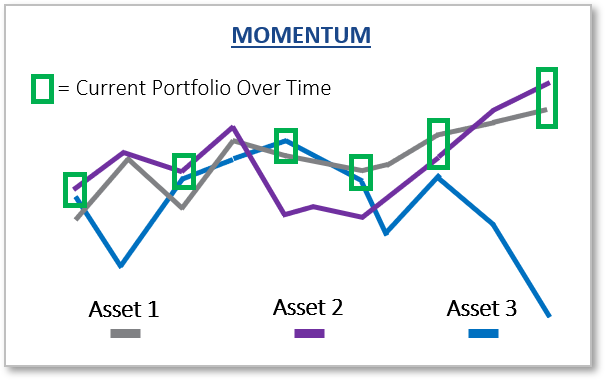
Illustration only. Not a recommendation to buy or sell any security.
Each month, 8A ranks a broad universe of liquid assets and selects the eight with the strongest trends (00:41). Weakening assets drop out. Acanto calls this persistent coincidental prediction: the process observes what is working now and does not forecast what should win next. For more, see Persistent Coincidental Prediction.
Momentum is widely studied. Eugene Fama, a 2013 Nobel laureate in economics, and Kenneth French called it "the premier anomaly" in a 2008 paper on U.S. stocks.1 The paper does not show that 8A or any momentum approach will produce a particular result. Trends can reverse, and a process that follows them may lag after sharp turns.
How does risk parity decide how much to own?
Risk parity decides position size. Lower-volatility holdings receive larger weights and more volatile holdings receive smaller weights, so no position dominates portfolio risk (01:30).
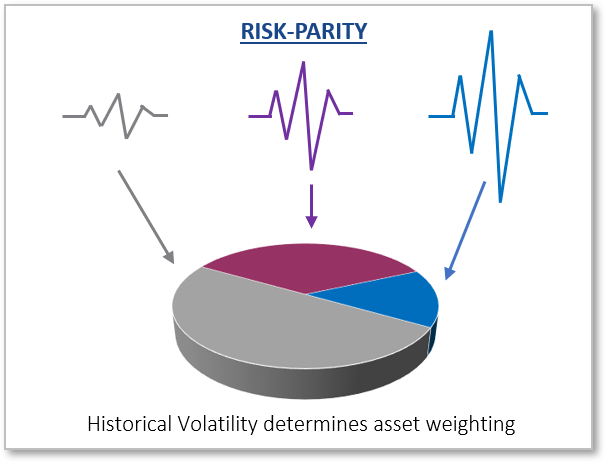
Illustration only. Not a recommendation to buy or sell any security.
Traditional risk parity generally keeps a fixed set of assets. 8A first removes weakening assets with momentum, then sizes only the assets that remain. Volatility looks backward, so sizing by it can misjudge risk when conditions change quickly.
Why rules matter
- Market data, not a forecast, determines what the rules buy and sell.
- Following written rules may help reduce emotion-driven decisions. It does not remove risk, and losses remain possible.
How does 8A adapt when markets change?
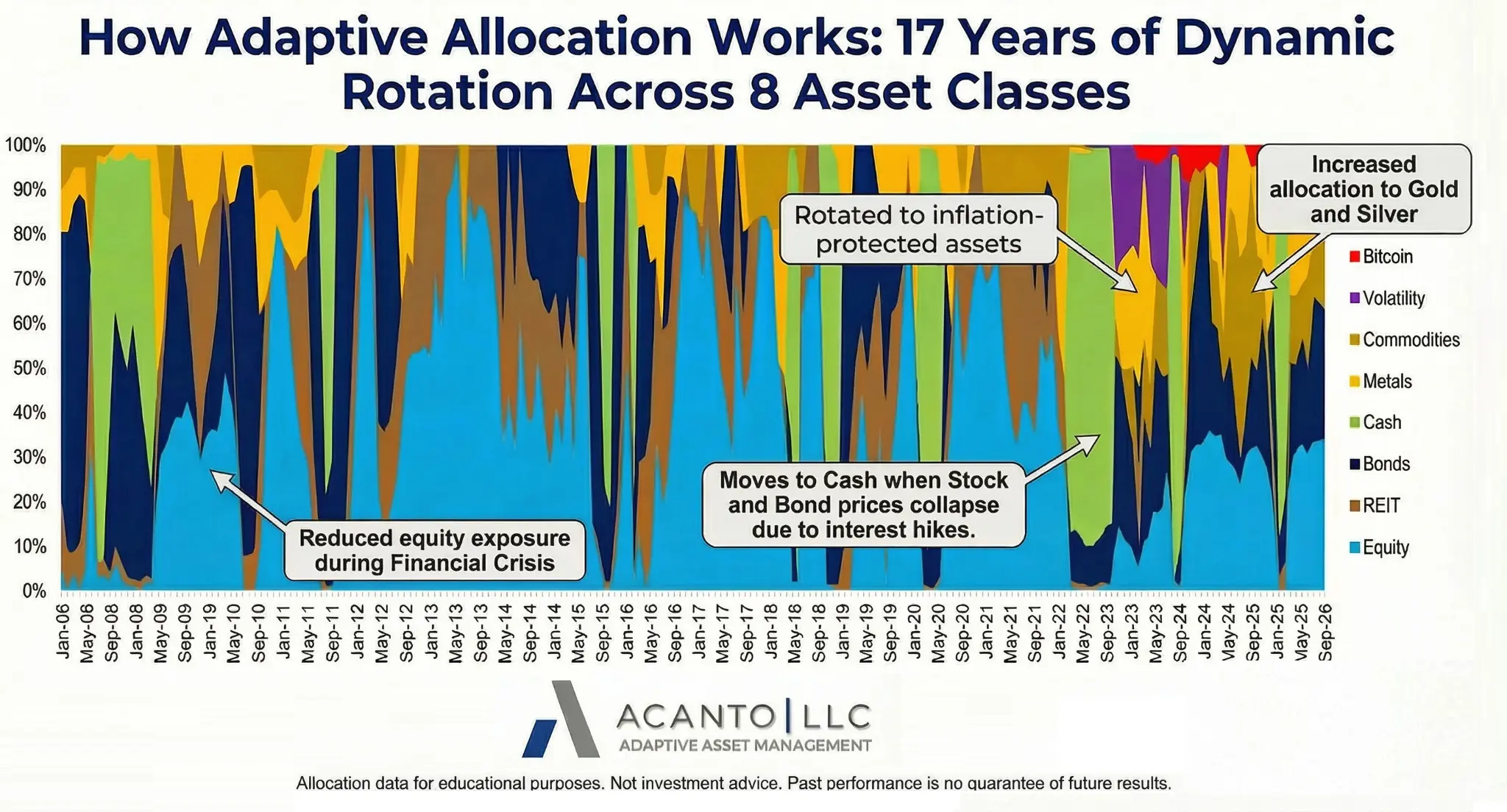
Ranking and sizing repeat each month, so holdings change when market leadership changes. The video describes allocations moving toward cash, commodities, and energy in 2022, a year when stocks and bonds fell together (01:56).
Does 8A depend on one perfect setting?
The research tests 4,228 parameter combinations to check that results do not hinge on one setting (02:34). A broad result across settings is not a guarantee of future behavior.
Hypothetical backtested results. Not actual client results.
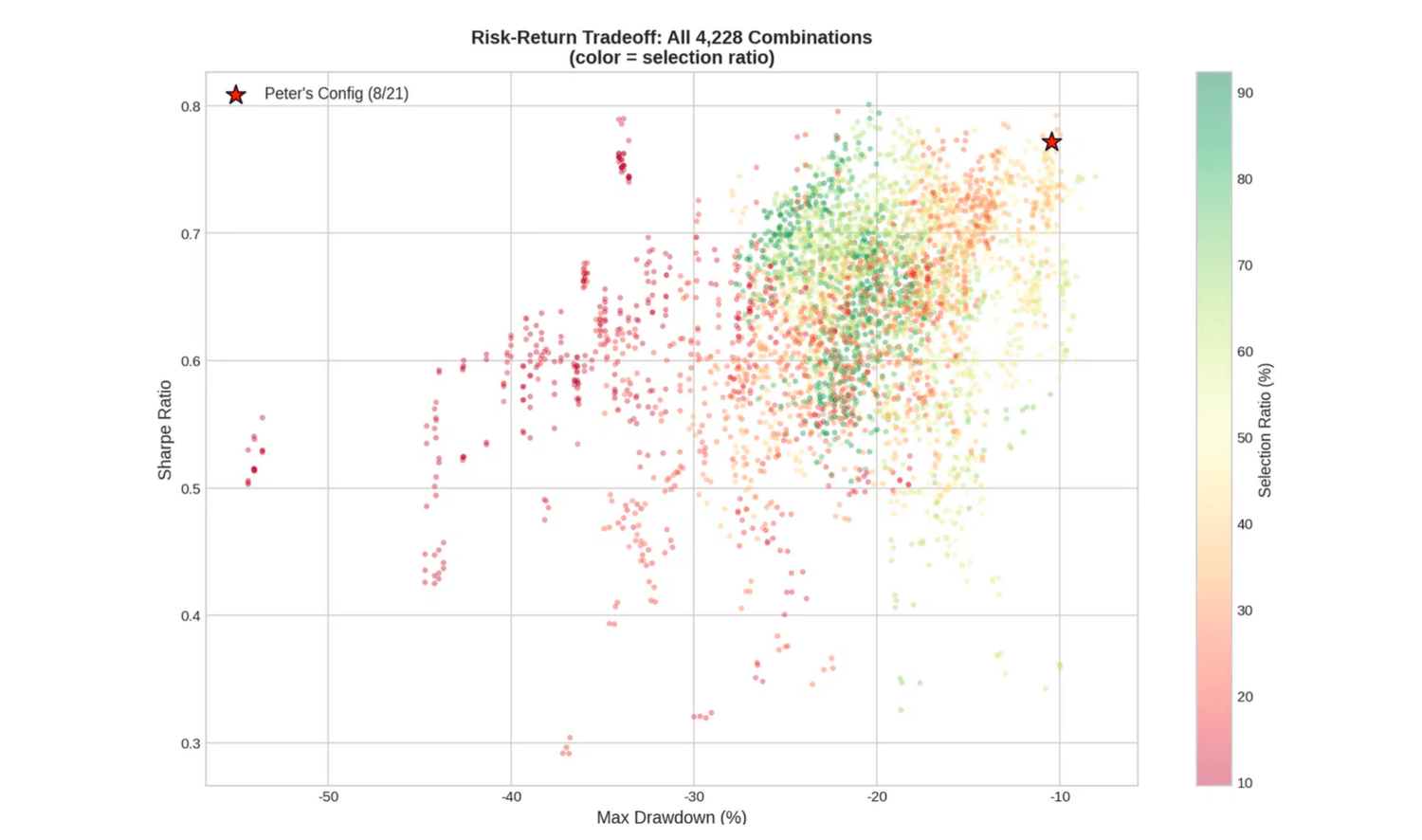
Figure 1. Risk-return tradeoff of all 4,228 parameter combinations tested. Each dot is one configuration tested across lookback schemes, volatility windows, weighting methods, and universe sizes. The horizontal axis is maximum drawdown and the vertical axis is Sharpe ratio. Color shows the selection ratio (top-N divided by universe size). The red star marks the current 8A configuration, labeled "Peter's Config (8/21)" in the chart. Positions reflect historical test results, and a configuration that looks favorable in hindsight may not behave the same way in the future. Sharpe ratio is a measure of return per unit of risk, and maximum drawdown is the largest peak-to-trough decline in the test period. Both are calculated from past data. Hypothetical backtested results, not actual client results; actual results may differ. Hypothetical performance has inherent limitations, does not represent actual trading, and is not a guarantee of future results. Source: Acanto LLC grid search analysis, from Acanto's Adaptive 8A research paper.
How should the research results be read?
Results in the video come from hypothetical backtests with a modeled 1.00% annual advisory fee and 0.04% assumed trading slippage. They are not actual client results, and actual costs may differ. Live strategy tracking began in November 2021 and is shown separately from the simulation (02:34). 8A does not predict the future.
How does 8A fit into a broader financial plan?
8A is one part of an investment process. Whether any approach fits depends on goals, taxes, income needs, risk tolerance, and time horizon. See the Blended Portfolio Framework, Acanto's investment strategies, and financial planning services. An Asset-Map discovery session puts the full picture on one page first.
Frequently asked questions
How often does 8A change its holdings?
8A ranks its asset universe each month and selects the eight assets with the strongest trends. Holdings may change when the ranking changes. Trading costs and taxes can reduce results.
How is 8A different from traditional risk parity?
Traditional risk parity generally keeps a fixed set of assets. 8A first removes weakening assets using momentum, then sizes only the assets that remain.
Do the results in the video reflect actual client results?
No. The charts show hypothetical backtested results with a modeled fee and slippage. Live strategy tracking began in November 2021 and is shown separately.
Can an adaptive approach still lose money?
Yes. Any investment approach can lose money, including loss of principal. Adaptive rules cannot remove risk or guarantee an outcome.
Continue the planning conversation
Explore Acanto's financial planning services and investment strategies to see how planning and portfolio decisions may be considered together for your individual circumstances. To organize your own picture first, start your Asset-Map or get in touch.
Notes and sources
- Fama, E.F. and French, K.R. (2008). "Dissecting Anomalies." The Journal of Finance, 63(4), 1653-1678. doi.org/10.1111/j.1540-6261.2008.01371.x. Accessed October 5, 2026.
Third-party research is cited for context only. Its inclusion does not imply endorsement of, or affiliation with, Acanto or 8A.
Important disclosures
This article and the video it accompanies are provided by Acanto LLC, a Registered Investment Advisor, for general informational and educational purposes only. They are not individualized investment advice, an offer or solicitation, or a recommendation to buy or sell any security or adopt any investment strategy. Any portfolio allocations or examples shown are illustrative only. Investing involves risk, including possible loss of principal. Investment decisions should consider each investor's individual objectives, financial circumstances, risk tolerance, and other relevant factors.
Hypothetical backtested performance, not actual client results. Reflects a modeled 1.00% annual advisory fee and 0.04% assumed trading slippage. Actual costs may differ. Hypothetical backtested performance has inherent limitations, and there is no guarantee that any strategy will achieve its investment objectives or avoid losses. The strategy is subject to change or discontinuation at any time.
Acanto does not provide legal or tax advice. Please consult your tax and estate professionals about your own situation. Before investing, review Acanto LLC's Form ADV Part 2A.
00:10How can a portfolio participate in market opportunities while becoming more responsive to changing risk? That is the problem Acanto's Adaptive All Asset eight, or eight a, is designed to address. Momentum, what to own. The first layer is momentum, the tendency of assets already outperforming to continue outperforming for a time. Eugene Fama, who won the Nobel Prize, and Kenneth French called momentum the premier anomaly.
00:41Each month, 8a ranks a broad universe of liquid assets and selects the eight with the strongest trends. We call this persistent coincidental prediction. We are not forecasting what should win next. We are observing what is working and adapting as leadership changes. One hundred and fifty four years of evidence.
01:02The core signal was tested across one hundred and fifty four years of market history from 1871 through wars, depressions, inflation, bubbles, and crashes. It delivered competitive long term growth with materially lower risk than stocks alone. Risk parity, how much to own. The second layer is risk parity. Momentum tells us what to own, risk parity tells us how much.
01:30Lower volatility holdings receive larger weights and more volatile holdings receive smaller weights, so no position dominates portfolio risk. The world's largest hedge fund, Bridgewater, helped make risk parity famous. Traditional risk parity generally keeps a fixed set of assets. Eight a is different. Momentum removes weakening assets, then risk parity sizes only the winners.
01:56Adaptability in real time. In 2008, the model rotated toward treasuries and gold while equities collapsed. We deployed this strategy for clients in late twenty twenty one and in 2022 as stocks and bonds fell together, our clients portfolios shifted toward cash, commodities, and energy. As leadership changes, asset allocations shift accordingly as shown in the allocation map and the dark blue portfolio line reflects the result. Across the 22 ETF test, returns were comparable to the S and P 500 with roughly one quarter of its maximum drawdown.
02:34Testing 4,228 parameter combinations showed a broad robust result, not dependence on one perfect setting. Live record, purpose. Live strategy tracking began in November 2021 and is shown separately from the simulation. The objective is not to beat stocks every year. It is to pursue acceptable long term growth while reducing the severe drawdowns that interrupt compounding and damage investor behavior.
03:04That makes eight a valuable on its own and as a risk on risk off engine for other strategies. It does not predict the future. It adapts to the evidence in front of us.