Financial Planning
What Is Holistic Financial Planning? How a Connected Plan Works
What holistic financial planning means, what it coordinates, and how the Asset-Map® Discovery Session starts the process. General education only.
What is holistic financial planning?
Holistic financial planning means managing your finances as one connected system, including investments, retirement income, taxes, insurance, and estate coordination, instead of working on one goal at a time.
- Investments
- Retirement income
- Taxes
- Insurance
- Estate coordination
The aim is to see how each decision may affect the others.
It does not remove market risk or guarantee any result. General education, not personalized advice.
 Illustration for education only. Not legal, tax, or investment advice.
What is a holistic approach to financial planning?
A holistic approach starts with the whole household, not a single account or product. It looks at what you own, what you owe, what income you may need, and who else is involved in your financial life, such as your attorney, tax professional, and insurance broker.
Then it asks how the pieces may interact. For example:
- A retirement withdrawal may affect taxes.
- A beneficiary designation may not match your estate documents.
- An insurance gap may change how much risk a household can reasonably take with its investments.
Seeing these links early may help you ask better questions. It does not decide the answers for you, and every household is different.
How is holistic planning different from investment-only advice?
Investment-only advice focuses on the portfolio: what to hold, how much risk to take, and how to review it over time. That work matters, but it usually leaves out the rest of the picture.
- Investments
- Retirement income
- Insurance
- Estate documents
- Tax questions
- Other professionals
Neither is right for everyone
Illustration for education only. Not legal, tax, or investment advice.| Investment-only approach | Holistic approach | |
|---|---|---|
| Starting point | The portfolio | The whole household picture |
| Typical questions | How should this money be invested? | How do investments, income, taxes, insurance, and estate documents fit together? |
| Other professionals | Often work separately | May be brought into one shared conversation, with your permission |
| Limits | May miss gaps outside the portfolio | Still depends on good information and does not remove risk |
Neither approach is right for everyone. Some people want help with investments only, and that is a reasonable choice. A holistic approach may suit people whose finances involve several moving parts, such as a pending retirement, a business, a blended family, or a recent loss of a spouse.
If you are comparing types of professionals, our guide to the difference between a financial planner, a financial advisor, and a fiduciary explains the titles and the questions to ask.
What areas does a holistic plan coordinate?
The exact list depends on the household. Common areas include:
- Retirement income: where spending money may come from and when, which could include savings, Social Security, pensions, and other sources.
- Cash-flow planning: what comes in, what goes out, and how that may change over time.
- Scenario testing: how a plan may hold up under different assumptions, such as a longer life, higher spending, or weak markets early in retirement.
- Downside risk management: how much loss a household may be able to tolerate, and what could be done about it. Losses are still possible.
- Estate coordination: reviewing accounts, titles, and beneficiary designations alongside the legal documents your attorney prepares.
- Insurance review: looking at life, disability, and long-term care questions with a licensed insurance broker.
- Investments: how the portfolio fits with the rest of the plan.
Taxes run through nearly every item on this list. We do not provide tax or legal advice. These are topics to raise with your CPA and attorney.
- Retirement incomeWhere spending money may come from
- Cash-flow planningWhat comes in and goes out
- Scenario testingLonger life, higher spending
- Downside riskHow much loss may be tolerable
- Estate coordinationTitles, beneficiaries, documents
- Insurance reviewLife, disability, long-term care
Illustration for education only. Not legal, tax, or investment advice.To see how we think about estate-related coordination, read our page on financial planning and estate coordination.
What does the process look like?
At Acanto, a holistic process begins with the Asset-Map® Discovery Session. It is a visual way to put your financial pieces on one page before any recommendations are made.
- Online exercise. You complete a secure online Asset-Map®, which typically takes about 15 to 30 minutes. It captures accounts, income, insurance, and liabilities. Estimates are fine.
- Video session. An approximately one-hour video session follows. We review what the map shows, point out gaps and overlaps, and talk about possible next steps.
- Coordination. With your permission, the summary can be shared with your attorney, tax professional, and insurance broker, so each person works from the same picture.
- Ongoing review. Plans generally change as life changes, so a plan may be more useful when it is revisited from time to time.
- Online Asset-Map®Accounts, income, insurance, liabilitiesAbout 15 to 30 min
- Video sessionReview the map, spot gaps and overlapsAbout 1 hour
- CoordinationShare the summary with your professionalsWith your permission
- Ongoing reviewRevisit as life changesFrom time to time
One page first. Recommendations after.
Illustration for education only. Not legal, tax, or investment advice.The Asset-Map® also looks at six areas we call the Six L's:
- Liquidity
- Long-Term Disability
- Life Insurance
- Long-Term Care
- Longevity
- Legacy
These give the conversation a simple structure. They are prompts for discussion, not a measure of how well any household is doing.
- Liquidity
- Long-Term Disability
- Life Insurance
- Long-Term Care
- Longevity
- Legacy
Prompts for discussion, not a score
Illustration for education only. Not legal, tax, or investment advice.You can read more about the session on our Asset-Map® page.
How does coordination with your other professionals work?
Acanto is an independent Registered Investment Adviser. We work in an open-architecture model, which means we work alongside a network of independent professionals, including CFP® professionals, insurance brokers, and tax professionals, as well as the professionals a family already uses.
The usual roles look like this:
- Your attorney advises on wills, trusts, powers of attorney, and other legal documents.
- Your tax professional advises on tax preparation and tax questions.
- Your insurance broker recommends and sells insurance products. Insurance professionals may earn commissions.
- Acanto helps organize the full picture, raises questions for the other professionals, and looks at how investments and retirement income planning fit with the rest.
Coordination takes time, and it is only as good as the information each person has. It does not replace any of these professionals.
- Commit to work togetherIf the Asset-Map® shows it fits
- Load prior taxes and all accountsPrior tax returns and every account in one place
- Get your forecast and Generational VaultForecast plus secure document storage
- Meet every yearAnnual review. Quarterly reviews for investment management clients, or any time you ask.
Shared with your permission
- Your attorney
- Your tax professional (CPA)
- Your insurance broker
Each professional keeps their own role. Forecasts rely on assumptions and are not guarantees.
Illustration for education only. Not legal, tax, or investment advice.Who may find a holistic approach useful?
It may be worth a closer look if one or more of these describes you:
- You are within a few years of retirement and want to understand how income may work.
- You own a business and your company and personal finances overlap.
- You have recently lost a spouse and are unsure what has changed in your plan.
- You have accounts, policies, and documents spread across several firms and professionals.
- You are changing careers and want to see how that may affect the longer-term plan.
For more on specific situations, see our articles on retirement income planning, business owner financial planning, and wealth management for retirees.
What a holistic plan cannot do
A connected plan can bring clarity, but it has limits:
- It does not remove market risk, and losses are possible.
- It cannot predict markets, tax law changes, health, or how long you may live.
- It does not guarantee any investment, tax, legal, or retirement result.
- It does not replace your attorney, tax professional, or insurance broker.
- It cannot make decisions for you. It is a way to see the trade-offs more clearly.
- It is only as accurate as the information and assumptions behind it.
- Show how the pieces connect
- Spot gaps and overlaps
- Compare scenarios and trade-offs
- Prepare questions for your professionals
- Remove market risk
- Predict markets, tax law, or lifespan
- Guarantee any result
- Replace your attorney, tax professional, or broker
Only as accurate as the information and assumptions behind it
Illustration for education only. Not legal, tax, or investment advice.Frequently asked questions
What is holistic financial planning?
Holistic financial planning is a way of managing finances as one connected system. It looks at investments, retirement income, taxes, insurance, and estate coordination together, rather than one goal at a time. It does not remove risk or guarantee outcomes.
Is holistic financial planning the same as wealth management?
Not always. The terms are used in different ways by different firms. Wealth management often centers on investments, while holistic planning looks at the full household picture. When comparing firms, ask what each service covers and how the firm is paid.
Do I need a lot of assets to benefit from a holistic approach?
There is no set amount. What matters more is how many moving parts your finances have. A household with several accounts, an upcoming retirement, a business, or an estate to coordinate may have more to connect, whatever its size. Whether it makes sense for you depends on your situation.
What happens in the Asset-Map® Discovery Session?
You complete a secure online exercise, which typically takes about 15 to 30 minutes, to list accounts, income, insurance, and liabilities. An approximately one-hour video session follows to review the findings and talk about possible next steps. No recommendations are made before the picture is on one page.
Do I still need an attorney and a tax professional?
Yes. Acanto does not provide legal or tax advice. A holistic process helps organize the picture and prepare questions, while your attorney and tax professional advise on legal documents and taxes.
Next steps
If you would like to see your own finances on one page, start with the Asset-Map® Discovery Session. It is a no-obligation way to see where things stand before any decisions are made.
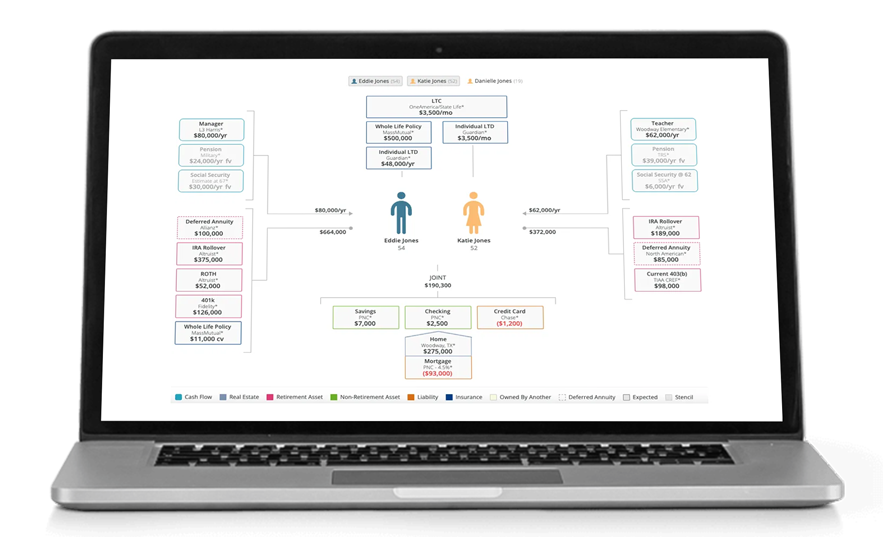
- Accounts, income, insurance, and liabilities on one page
- See the whole picture before any recommendations are made
- Then talk through possible next steps, if and when they fit
Prefer to talk first? Pick a date and time that works for you, or review the Asset-Map® Discovery Session details.
Important disclosures
This article is provided by Acanto LLC, a Registered Investment Advisor, for general informational and educational purposes only. It is general education, not personalized advice. Registration does not imply a certain level of skill or training. It is not legal, tax, or investment advice, an offer or solicitation, or a recommendation that any approach suits you. Investing involves risk, including the possibility of loss of principal, and no investment strategy can guarantee a profit or protect against loss. Tax, legal, and insurance rules vary by state and change over time. Acanto does not provide legal or tax advice; consult a qualified attorney and tax professional. Insurance professionals may earn commissions, and the discussion of insurance is general education, not a recommendation of any product. For more about Acanto's services, fees, and business practices, review Form ADV Part 2A, available upon request or at adviserinfo.sec.gov.