Retirement & Wealth Planning
Wealth Management for Retirees: How the Pieces of Your Financial Life Work Together
A practical, educational look at how retirement income, investments, taxes, insurance, and estate decisions connect.
What is wealth management for retirees?
Wealth management for retirees is an ongoing process that coordinates retirement income, investments, taxes, insurance, and estate decisions as one plan instead of separate tasks. It starts with a complete picture of what you own and owe. Coordination can help reveal conflicts between decisions, but it cannot remove market risk, and losses remain possible.
Most people reach retirement with accounts opened at different times, for different reasons, often with different firms. A workplace plan here, an IRA there, a brokerage account, a life insurance policy purchased years ago, and a will that may not have been reviewed since the children were young. Each piece made sense when it was created. The question retirement raises is whether they still work together.
This article explains what wealth management means in plain terms, why the coordination matters more once paychecks stop, and how each major area of a retiree's financial life affects the others. It is educational and general in nature, and it does not replace advice tailored to your own circumstances.
How is wealth management different from investment management?
Investment management focuses on one question: how should the portfolio be invested given your goals, time horizon, and tolerance for risk? That is an important question, but it is only one part of a retiree's financial life.
Wealth management is broader. It treats the portfolio as one input alongside Social Security, pensions, spending needs, tax brackets, health and long-term care costs, insurance coverage, and what you want to leave to others. The goal is not to add complexity. It is to make sure decisions in one area do not quietly work against decisions in another.
A simple example: selling investments to fund spending can create a tax bill, which changes how much you need to withdraw, which changes how much remains invested. No single decision is made in isolation, so it helps to see them together.
- You need money to spend
- Investments are sold to fund it
- A tax bill may result
- Less remains invested
The result feeds back into the next withdrawal decision.
Why does coordination matter more as retirement approaches?
During your working years, a paycheck covers most spending and new savings can absorb many mistakes. In retirement, the portfolio, Social Security, and any pension have to replace that paycheck, and the order in which money is withdrawn can matter.
Retirees and pre-retirees also face a set of decisions that tend to cluster in a short window: when to claim Social Security, how to handle workplace retirement accounts, whether to review insurance, how to prepare for health care costs, and whether estate documents still reflect current wishes. Several of these choices are difficult or impossible to reverse, which is a reason to consider them together before acting on any one of them.
Career transitions, the loss of a spouse, the sale of a business, or an inheritance can bring the same questions forward on a shorter timeline.
Decisions that often arrive in the same short window
- 1When to claim Social Security
- 2How to handle workplace retirement accounts
- 3Whether to review insurance
- 4How to prepare for health care costs
- 5Whether estate documents still fit
Some of these choices are hard to reverse, so they are often considered together.
How do cash flow and retirement income fit together?
Retirement income planning starts with cash flow: what you expect to spend, what is essential versus flexible, and which sources of income will cover it. Guaranteed or predictable sources, such as Social Security or a pension, are usually considered first. The remaining gap is typically met from savings and investments.
That gap is where coordination shows up. Which account to draw from first, how large a withdrawal to take, how to hold enough in cash or stable assets to cover near-term spending, and how to adjust if expenses change are all planning decisions, not just investment decisions. Reasonable people reach different answers because their spending, health, family situations, and comfort with uncertainty differ.
Required minimum distributions from certain retirement accounts also affect income. The age at which they begin depends on federal law and your birth year, so it is worth confirming the current rules with a tax professional or the IRS rather than relying on a rule of thumb.
How does investment risk affect retirement income?
A portfolio that falls in value while you are saving is uncomfortable. A portfolio that falls while you are withdrawing from it can be more damaging, because shares sold at lower prices are no longer there to recover. This is often called sequence-of-returns risk, and it is one reason retirees tend to think about risk differently than they did while working.
Managing that risk involves trade-offs. Holding more in lower-volatility assets may reduce the size of potential declines, but it may also reduce long-term growth and leave less protection against inflation. Holding more in growth assets may support spending over a long retirement, but it exposes the portfolio to larger swings. Neither choice is free of risk, and no approach can guarantee against loss.
Acanto's investment approach uses rules-based, adaptive frameworks that respond to observed market conditions rather than forecasts. You can read about them on the investment strategies page. Any strategy, including these, involves risk and may lose money.
Why a decline can matter more once you are withdrawing
- The portfolio falls in value
- Spending still has to be funded
- More shares are sold at lower prices
- Fewer shares remain to recover
How do taxes shape retirement decisions?
Taxes touch nearly every retirement choice. Money held in pre-tax accounts, Roth accounts, and taxable accounts is taxed differently when it is withdrawn, so the same dollar of spending can have different after-tax costs depending on where it comes from. Realized gains, Social Security taxation, and income-based Medicare premiums can also respond to how much income you report in a given year.
Some households consider spreading withdrawals across account types, or evaluating Roth conversions in lower-income years. Whether those ideas make sense depends on current and expected future tax rates, other income, and what heirs may inherit. They are not right for everyone, and they can increase taxes in the year they are done.
The same dollar of spending can come from three kinds of accounts
Pre-tax accounts
Traditional IRA, traditional 401(k)
Withdrawals are generally taxed as ordinary income.
Roth accounts
Roth IRA, Roth 401(k)
Qualified withdrawals are generally not taxed.
Taxable accounts
Brokerage and bank accounts
Gains and interest are generally taxed in the year they are realized or earned.
Tax rules change and individual facts matter. Acanto does not prepare tax returns or provide tax advice, and works alongside a household's tax professional so that investment and withdrawal decisions can be reviewed with the tax picture in view.
Where does insurance fit into a retirement plan?
Insurance in retirement is about identifying the financial risks that would be difficult to absorb from savings. Common areas to review include health coverage and Medicare choices, the possibility of long-term care needs, and whether existing life insurance still serves a purpose, such as providing for a surviving spouse or supporting an estate plan.
Policies bought decades ago may no longer match current needs, and different policy types carry different costs, guarantees, and limitations. The useful question is not which product to buy, but what risk is being addressed, how large it is, and how the answer fits with the rest of the plan. Our article on how life insurance may fit into a broader financial plan covers that discussion in more detail.
How do estate documents connect to the rest of the plan?
Wills, trusts, powers of attorney, and healthcare directives describe your intentions. Whether those intentions are carried out often depends on how accounts are titled and who is named as beneficiary, because beneficiary designations on retirement accounts and insurance policies can control who receives those assets regardless of what a will says.
That is why estate decisions belong in the same conversation as income and investment decisions. A trust that was signed but never funded, or a beneficiary form that was never updated after a life event, are common gaps. Estate documents should be drafted by a qualified estate planning attorney, and Acanto does not provide legal advice. For a deeper look at this area, see our guide to estate planning essentials for high-net-worth families.
Items worth reviewing together
- Will
- Trust, and whether it has been funded
- Powers of attorney
- Healthcare directive
- Beneficiary designations
- How accounts are titled
How can an Asset-Map® discovery session organize the conversation?
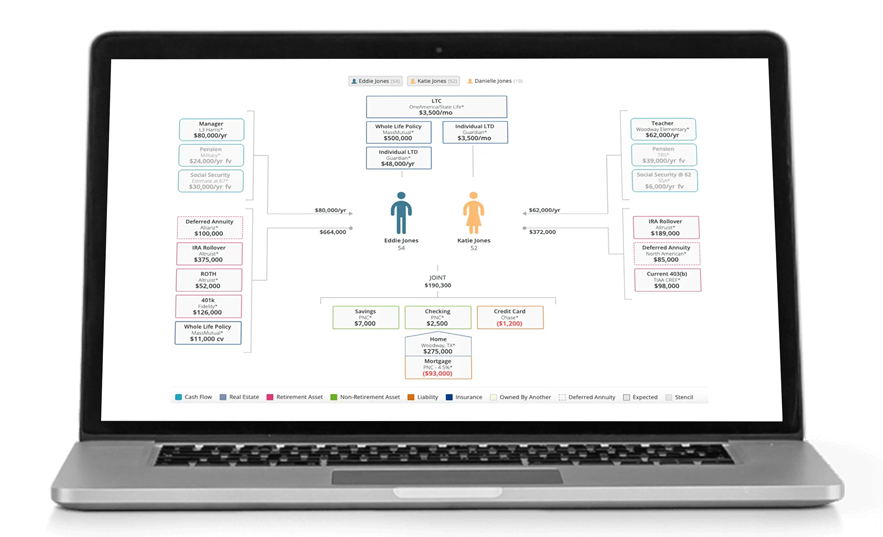
Every area above depends on having an accurate, complete picture. Acanto starts there. The Asset-Map® discovery session brings accounts, income, insurance, liabilities, and key estate documents onto a single visual page, so that you and your advisor can see how the pieces connect and where there may be gaps, overlaps, or items that are out of date.
As described among Acanto's wealth planning and investment management services, the session typically takes about 15 to 30 minutes to complete securely online and is followed by an approximately one-hour video review to discuss findings and possible next steps. It is a starting point for the conversation, not a recommendation to take any particular action.
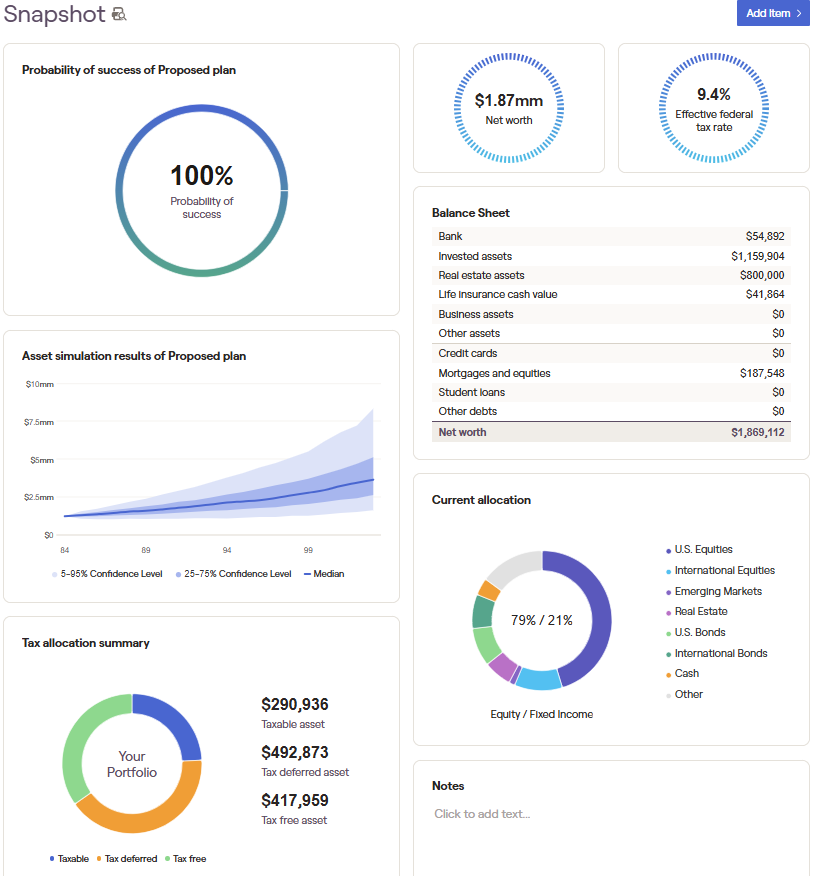
From there, the work can move into a retirement analysis, cash flow planning, scenario testing, and, where appropriate, ongoing investment management. You can learn what the process involves on the Asset-Map® discovery session page.
What should I ask when evaluating a wealth management firm?
Firms describe wealth management differently, so it helps to ask specific questions. The following are a reasonable starting point:
- What services are included, and which are handled by outside professionals?
- How is the firm paid, and what conflicts of interest could that create?
- How does the firm coordinate with your attorney, tax professional, and insurance broker?
- What does the firm need to learn about you before making any recommendation?
- How are investment risks, fees, and limitations explained in writing?
Any registered investment adviser provides a Form ADV that describes its services, fees, and conflicts. Reading it is a useful step before you commit to any firm.
Frequently asked questions
Is wealth management only for people with very large portfolios?
No single threshold defines it. The need for coordination tends to depend more on complexity than on size: multiple account types, a business, an inheritance, or family considerations can make coordination valuable at different asset levels. Individual firms set their own service and fee structures, so it is worth asking directly.
When should someone start thinking about wealth management before retiring?
Many people begin several years before their expected retirement date, because decisions about Social Security, account types, and insurance can have longer-term effects. Starting earlier gives more time to review the options, though it is never too late to organize the full picture.
Does wealth management replace my attorney or accountant?
No. An estate planning attorney drafts legal documents and a tax professional prepares returns and advises on tax matters. Wealth management aims to coordinate with those professionals so that decisions are consistent across disciplines.
Can wealth management guarantee my money will last?
No. Markets, inflation, health, and spending can all differ from expectations. A coordinated plan can help you understand the range of possibilities and prepare for them, but it cannot guarantee any outcome.
Start With a Complete Picture
If you are approaching retirement or already retired, a useful first step is seeing your accounts, income, insurance, and estate documents in one place. Review Acanto's services or begin with an Asset-Map® discovery session. Prefer to start on your own? Download our free Financial Organization Checklist to gather your accounts, insurance, and estate documents in one place.
Peter Lusk, Jr., MBA, CMT
Founder & CIO, Acanto
This article is for general educational purposes only and does not constitute legal, tax, insurance, or individualized investment advice. Acanto LLC does not draft legal documents or prepare tax returns. Investing involves risk, including the potential loss of principal, and no strategy can guarantee a profit or protect against loss. Rules governing taxes, retirement accounts, Social Security, and estates change over time and depend on each person's individual facts and circumstances.
Consult a qualified estate planning attorney before creating or amending a will or trust, and a qualified tax professional regarding the tax treatment of any account or strategy discussed here. Nothing in this article should be understood as a guarantee of a particular legal, tax, or investment outcome. For more information about Acanto's services, fees, and business practices, review Form ADV Part 2A, available upon request or at adviserinfo.sec.gov.
Continue the planning conversation
Explore Acanto's financial planning services and investment strategies to see how planning and portfolio decisions may be considered together for your individual circumstances.