
Retirement Planning
Tax-Advantaged Retirement Accounts: How They Fit Together
How 401(k), IRA, Roth and HSA accounts differ in when tax is paid, and how a coordinated look may help pre-retirees. 2026 IRS limits. General education.
What are tax-advantaged retirement accounts?
Tax-advantaged retirement accounts are accounts that the tax code treats differently from ordinary savings. Traditional accounts generally defer tax until money is withdrawn, Roth accounts generally tax contributions now and may allow qualified withdrawals tax-free, and some accounts, such as an HSA, may offer tax benefits for qualified health costs.
- Employer plans
- Traditional IRAs
- Roth IRAs
- HSAs
Each has contribution limits and distribution rules, and which mix fits depends on individual circumstances. Money inside any of them can lose value.
Figures below are 2026 tax-year amounts published by the IRS. Limits change most years, so confirm current amounts with the IRS or a tax professional. General education, not personalized advice.
What counts as a tax-advantaged retirement account?
A tax-advantaged retirement account is one where the tax code changes when, or whether, tax applies to contributions, growth, or withdrawals. The most common types for people within ten years of retiring are:
- Employer plans, such as a 401(k), 403(b), or governmental 457(b). Many plans offer a pre-tax option, a Roth option, or both. The plan's own terms govern what is available.
- Traditional IRAs, where contributions may be fully or partly deductible depending on income and workplace plan coverage.
- Roth IRAs, where contributions are not deductible but qualified withdrawals are generally tax-free.
- Health savings accounts (HSAs), available only with a qualifying high-deductible health plan.
Each benefit comes with a limit. Deductions can phase out at higher incomes, Roth contributions have income limits, withdrawals before age 59½ may carry an additional 10% tax unless an exception applies, and none of these accounts removes investment risk. Money inside them can lose value.
Sources: IRS, Traditional IRAs, IRS, Roth IRAs, IRS, Tax on early distributions.
How do traditional, Roth, and employer plans differ in when tax is paid?
The central trade-off is tax now versus tax later. Pre-tax and deductible contributions may lower taxable income this year, but withdrawals are generally taxed as ordinary income. Roth contributions do not lower taxable income this year, but qualified withdrawals are generally tax-free. Neither is better in every case. The answer may depend on your current tax bracket, your expected future income, and how other income sources fit together.
- Where tax is generally paid
- Where the account generally gives a tax benefit
Income limits, early-withdrawal rules, and the five-year clock on some Roth withdrawals can change the picture.
 Illustration for education only. Not legal, tax, or investment advice. Figures are 2026 IRS amounts and change over time.
| Account type | When tax is generally paid | 2026 limits (IRS) |
|---|---|---|
| Traditional 401(k), 403(b), governmental 457(b) | Contributions generally pre-tax. Withdrawals taxed as ordinary income. | $24,500 employee limit. Catch-up of $8,000 at age 50 and over, or $11,250 at ages 60 to 63, where the plan allows. |
| Designated Roth 401(k) or 403(b) | Contributions made after tax. Qualified withdrawals generally tax-free. | Same employee limit as above, shared between pre-tax and Roth contributions. |
| Traditional IRA | Deduction depends on income and workplace plan coverage. Withdrawals taxed as ordinary income. | $7,500 combined with Roth IRAs. Catch-up of $1,100 at age 50 and over. |
| Roth IRA | Contributions made after tax. Qualified withdrawals generally tax-free. | $7,500 combined with traditional IRAs. Eligibility phases out between $153,000 and $168,000 (single) and $242,000 and $252,000 (married filing jointly). |
| Health savings account (HSA) | Contributions may be deductible or pre-tax. Qualified medical withdrawals generally tax-free. | $4,400 self-only coverage, $8,750 family coverage, plus $1,000 at age 55 and over. |
Sources: IRS, 401(k) limit increases to $24,500 for 2026, IRA limit increases to $7,500 (IR-2025-111, employer plan, IRA, and Roth IRA figures), IRS Revenue Procedure 2025-19 and IRS Publication 969 (HSA figures and rules).
401(k), 403(b), governmental 457(b)
Employee limit, shared between pre-tax and Roth contributions
IRA
Traditional and Roth IRAs combined
HSA, self-only coverage
With a qualifying high-deductible health plan
HSA, family coverage
With a qualifying high-deductible health plan
- Base annual limit
- Catch-up, added on top of the base limit
The limit is shared across account types where noted, so one contribution counts against the same cap.
Illustration for education only. Not legal, tax, or investment advice. Figures are 2026 IRS amounts and change over time.Which retirement accounts may reduce taxable income?
Contributions to a traditional 401(k), 403(b), or 457(b) are generally made before income tax, which may reduce taxable income for the year. Traditional IRA contributions may be deductible. For 2026, a single filer covered by a workplace plan sees the deduction phase out between $81,000 and $91,000 of income, and a married couple filing jointly sees it phase out between $129,000 and $149,000 when the contributing spouse is covered by a workplace plan. HSA contributions may also reduce taxable income when made for an eligible individual. These reductions are deferrals in most cases, not permanent savings, because withdrawals from pre-tax accounts are generally taxed later. Source: IRS, IR-2025-111.
Roth IRA contributions
Income range in which the allowed contribution is reduced
Single or head of householdReduced from $153,000 to $168,000
Married filing jointlyReduced from $242,000 to $252,000
Traditional IRA deduction, with a workplace plan
Income range in which the deduction is reduced
Single, covered by a workplace planReduced from $81,000 to $91,000
Married filing jointly, contributing spouse coveredReduced from $129,000 to $149,000
- Below the range: full amount
- Phase-out range: reduced
- Above the range: no Roth contribution, or no deduction
Other filing situations have other ranges. Confirm yours with the IRS or a tax professional.
Illustration for education only. Not legal, tax, or investment advice. Figures are 2026 IRS amounts and change over time.What if you have never held a Roth?
Some people in their late 50s and 60s have saved only in pre-tax accounts. That is common, and it is not a mistake. It does mean most future withdrawals may be taxable, which is one reason people ask how a Roth account could fit. Roth rules add timing questions, including a five-year clock on some withdrawals. These are topics to review with a tax professional, not a recommendation to open or fund any account.
Related reading: Roth IRA five-year rules explained.
How do these accounts interact with required distributions and Roth conversions?
Pre-tax accounts do not allow money to stay deferred indefinitely. Required minimum distributions (RMDs) generally begin at age 73 for people born from 1951 through 1959, and at age 75 for people born in 1960 or later. A missed or short RMD may trigger an excise tax of 25% of the amount not taken, or 10% if corrected within two years. Roth IRA owners generally have no RMDs during their lifetime, and the same is true for designated Roth accounts in employer plans while the owner is alive. Beneficiaries of Roth accounts are subject to distribution rules.
Catch-up contributions begin
Employer plans: up to $8,000 extra in 2026, where the plan allows. IRAs: up to $1,100 extra.
HSA catch-up
An eligible HSA owner may add $1,000 more.
Early-withdrawal tax rule
Withdrawals before age 59½ may carry an additional 10% tax unless an exception applies.
Higher employer plan catch-up
$11,250 instead of $8,000, where the plan allows.
Required minimum distributions begin
Age 73 if born from 1951 through 1959. Age 75 if born in 1960 or later. A missed or short RMD may trigger an excise tax of 25% of the amount not taken, or 10% if corrected within two years. Roth IRA owners generally have no lifetime RMDs.
Gold marks the point where a tax rule becomes mandatory, not optional.
Illustration for education only. Not legal, tax, or investment advice. Figures are 2026 IRS amounts and change over time.A Roth conversion moves money from a pre-tax account to a Roth account. The converted amount is generally added to taxable income in the year of the conversion, so the tax cost arrives now in exchange for a different tax treatment later. Whether that trade-off makes sense depends on current and expected tax brackets, the funds available to pay the tax, how it may interact with other income-based items, and the household's estate goals. Conversions generally cannot be reversed, so many people review the numbers with a tax professional before acting.
Related reading: Roth strategy for high earners and inheritance planning.
Sources: IRS, Retirement topics: Required minimum distributions (age 73 rule, excise tax, Roth treatment), IRS Bulletin 2024-33 (final RMD regulations, age 75 for those born in 1960 or later).
What does a coordinated look across accounts involve?
Each account type has its own rules, so decisions made one account at a time can pull against each other. A coordinated look generally asks:
- Where does each dollar sit? Pre-tax, Roth, HSA, and taxable accounts may be taxed differently when money comes out.
- In what order might withdrawals come? Drawing from different accounts in different orders may change the tax cost of the same spending.
- When do RMDs begin, and how large might they become? Large pre-tax balances may lead to larger required withdrawals.
- Could lower-income years leave room to consider Roth conversions? This is a question for a tax professional, and results vary.
- Who are the beneficiaries? Beneficiary designations on retirement accounts generally override a will.
- How do Social Security timing, health care costs, and spending needs fit in?
Four kinds of accounts, taxed differently when money comes out
- Pre-taxWithdrawals generally taxed as ordinary income
- RothQualified withdrawals generally tax-free
- HSAQualified medical withdrawals generally tax-free
- TaxableTaxed under its own rules when money comes out
Six questions a coordinated look asks
- Where does each dollar sit?Pre-tax, Roth, HSA, and taxable accounts
- In what order might withdrawals come?Order may change the tax cost of the same spending
- When do RMDs begin, and how large might they become?Large pre-tax balances may mean larger required withdrawals
- Could lower-income years leave room to consider Roth conversions?A question for a tax professional. Results vary.
- Who are the beneficiaries?On retirement accounts, designations generally override a will
- How do Social Security, health care costs, and spending fit in?Timing and needs shape which account may be used first
Illustration for education only. Not legal, tax, or investment advice. Figures are 2026 IRS amounts and change over time.None of these questions has a single right answer, and the answers may change as tax rules and circumstances change. At Acanto, this review often starts with the Asset-Map® Discovery Session, which places accounts, income, insurance, and liabilities on one page before any recommendations are made. We coordinate with your tax professional and do not provide tax or legal advice.
Related reading: Retirement income planning and sequence of returns risk and wealth management for retirees.
Frequently asked questions
What are the tax advantages of a qualified retirement plan?
A qualified employer plan, such as a 401(k), may let contributions go in before income tax and may let investments grow without current tax on the growth. Tax is generally due when money is withdrawn. A Roth option in the same plan reverses the timing. The advantages come with limits: annual contribution caps, distribution rules, RMDs on pre-tax balances, and an additional 10% tax on many withdrawals before age 59½. Investments in the plan can lose value.
Which retirement accounts may reduce taxable income?
Traditional 401(k), 403(b), and 457(b) contributions, deductible traditional IRA contributions, and HSA contributions for eligible individuals may reduce taxable income in the year they are made. Roth contributions do not. Eligibility and deduction limits depend on income, filing status, and workplace plan coverage, and withdrawals from pre-tax accounts are generally taxed later.
What is the difference between a traditional and a Roth account?
A traditional account generally gives a tax benefit when money goes in and taxes withdrawals. A Roth account generally taxes money going in, and qualified withdrawals may be tax-free. The two time the tax differently, and which may suit a household depends on its situation. Many households hold both.
Do I have to take withdrawals from every retirement account?
No. RMDs generally apply to traditional IRAs and pre-tax employer plan balances once the owner reaches the required age, which is 73 or 75 depending on birth year. Roth IRA owners generally have no lifetime RMDs, and HSAs do not have RMDs. Employer plan rules can differ, so confirm the terms of your plan.
Is there a limit on how much I can put into these accounts?
Yes. For 2026, the IRS employee limit for a 401(k) is $24,500 and the IRA limit is $7,500, with higher catch-up amounts at certain ages. HSA limits depend on the type of coverage. Roth IRA eligibility phases out at higher incomes. Limits change most years, so confirm current figures with the IRS.
Start with the full picture
A guide like this cannot say which accounts suit you. Seeing every account, its tax treatment, and its rules on one page is a reasonable first step. Your Asset-Map® Discovery Session is complimentary.
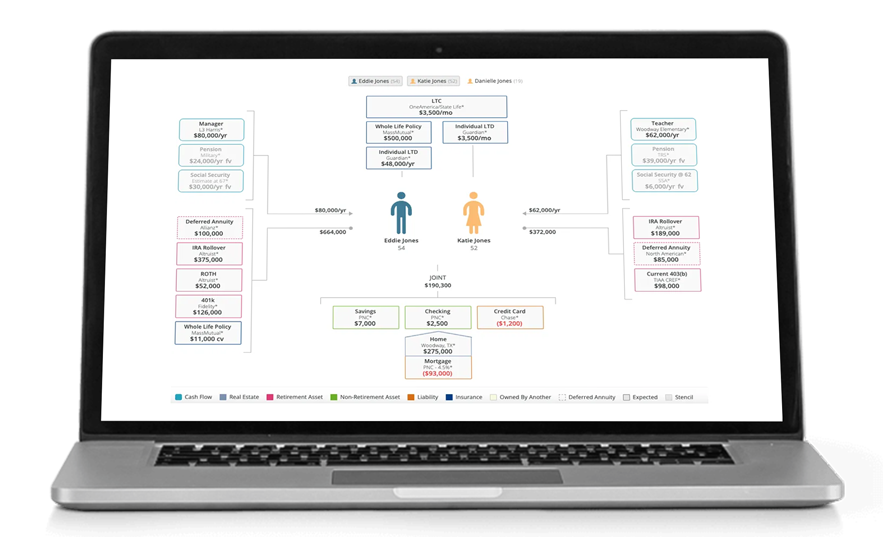
- Every account, with its tax treatment, on one page
- Pre-tax, Roth, HSA, and taxable balances side by side
- Then prepare questions for your tax professional
Prefer to talk first? Pick a date and time that works for you, or review the Asset-Map® Discovery Session details.
A starting point for the conversation, not a recommendation to take any action. Each household's Asset-Map is different.
Important disclosures
This article is provided by Acanto LLC, a Registered Investment Advisor, for general informational and educational purposes only. It is general education, not personalized advice. Registration does not imply a certain level of skill or training. It is not legal, tax, or investment advice, an offer or solicitation, or a recommendation that any account type or strategy suits you. Investing involves risk, including the potential loss of principal, and no investment strategy can guarantee a profit or protect against loss. Contribution limits, income thresholds, and distribution ages are 2026 figures from the IRS sources linked above and change over time. Tax rules also vary by state and individual circumstances. Acanto does not provide legal or tax advice; consult a qualified tax professional and attorney about your own situation. For more about Acanto's services, fees, and business practices, review Form ADV Part 2A, available upon request or at adviserinfo.sec.gov.