Retirement Planning
How to Build a Retirement Game Plan With an Asset-Map®
A retirement game plan gives each part of your finances a job. See how an Asset-Map® and the six L's may help you spot gaps and explore what-if questions.
A retirement game plan gives every part of your finances a job, so you can see how decisions fit together before you make them. In this short video, we use a polo team as the analogy: some holdings may aim for growth, some can adjust as conditions change, some may add income and balance, and some are there for near-term needs. An Asset-Map® puts that picture on one page, and the six L's help point out possible gaps. It is a starting point for questions, not a prediction or a promise.
The examples shown in the video are hypothetical, based on backtesting, and are not actual client results. Backtested results have limitations and do not guarantee future results.Key takeaways
Life and markets change
A retirement game plan may need to change with them.
Every part has a job
Each job carries its own costs, risks and trade-offs.
One page, two questions
What do I own, and what do I owe? An Asset-Map® puts the answers side by side.
Six L's, six prompts
Discussion prompts for spotting possible gaps. They are not a score.
What-ifs, not forecasts
Scenarios are questions to explore with your family and professionals.
Clarity First. Strategy Second. Integrity Always.
Why does a retirement plan need a game plan when markets keep changing?
A retirement plan needs a game plan because your life and the financial markets both change over time, and a plan built for one moment may not fit the next. The video opens on this idea at (00:08) with a simple question: "If every rider chases the ball, who's defending the goal?"
In a portfolio, chasing the ball can look like moving everything toward whatever has done well lately. A game plan first asks what job each part of the portfolio has.
Part of how we approach that question is a rules-based adaptive approach. In plain terms:
- Price trends: research has found that asset classes that led for a period have, at times, kept leading for a while. We look at those trends when deciding what to own.
- Position sizing: holdings that have been more volatile may receive smaller weights, and steadier holdings may receive larger ones.
- Regular review: the mix can change as conditions change, rather than staying fixed.
Each of these comes with limitations. Trends can reverse suddenly, and a rules-based approach may be slow to respond at turning points. Volatility can change without warning, so sizing positions this way does not remove risk. More frequent changes can also create trading costs and taxes. Investing involves risk, including the possible loss of principal, and any approach can underperform.
No single method is right for everyone. The aim is to make the reasoning behind what to own, and how much, clear enough to discuss. The polo team below shows how those jobs can fit together.
How can an Asset-Map® show whether every part of your plan has a job?
An Asset-Map® can show whether every part of your plan has a job by placing your accounts, income, insurance and liabilities on one page, where roles, gaps and overlaps are easier to see. The video turns to this at (01:03), comparing a family's plan to a polo team in which every position has a role.
Every position has a job
On the polo field, offense, midfield, income and balance, and defense each play a different part. The same idea can apply to a household's finances. Each job also has a trade-off, shown beside it.
Offense
Holdings that seek long-term growth
Trade-off: Growth-oriented holdings may see larger swings in value.
Midfield
Holdings that can shift as conditions change, using rules based on price trends and volatility
Trade-off: May lag at turning points, and trading can add costs and taxes.
Income and balance
Holdings that seek to diversify sources of income and exposure
Trade-off: Diversification does not guarantee a profit or prevent losses.
Defense
Cash reserves for near-term spending, and insurance coverage for the people who depend on your income
Trade-off: Insurance has costs, limits and exclusions.
Clarity First. Strategy Second. Integrity Always.
Clarity: the Asset-Map® puts the picture on one page. Strategy: choices are discussed once the picture is clear. Integrity: costs, risks and possible conflicts are explained.
 The polo field is an analogy, not a prediction or a recommendation. Categories are types of tools, not specific products. Losses are possible.
What do I own, and what do I owe?
The Asset-Map® starts with two plain questions: what do I own, and what do I owe? Seeing the answers together may help a family notice what is hard to spot across separate statements, such as coverage that no longer matches the household.
Checking for gaps across the six L's
We then look for possible gaps across six areas, which we call the six L's: liquidity, long-term disability, life insurance, long-term care, longevity and legacy. Each one comes with a question worth discussing.
L1
Liquidity
Is there cash you can reach for needs and opportunities?
L2
Long-term disability
How might income continue if illness or injury stopped work?
L3
Life insurance
How might the people who depend on you manage if something happened to you?
L4
Long-term care
How might extended care and its costs be handled?
L5
Longevity
How might savings and income support a long life?
L6
Legacy
Do your documents and beneficiary forms reflect your wishes?
Illustration for education only. Every household weighs these areas differently. Not a recommendation of any product.These are prompts for discussion. Every household weighs them differently.
Testing a what-if: retiring five years earlier
When you become a client, we run several scenarios to see how your assets fit together. The video poses one example: what if you retired five years earlier? That one question opens others worth exploring with your family and professionals.
- Which account would fund those extra five years?
- What might that mean for your taxes?
- How could it affect your spouse's income?
- What might it mean for your legacy?
Scenarios rely on assumptions about markets, spending, taxes and health. They illustrate possibilities and are not predictions.Scenarios rely on assumptions about markets, spending, taxes and health. They illustrate possibilities and are not predictions of what will happen. You can read more on our Asset-Map® Discovery Session page. For a written walk-through of the same team idea, see Building a Retirement Plan That Works for Your Life.
What does "clarity first, strategy second, integrity always" mean for your plan?
"Clarity first, strategy second, integrity always" means we aim to understand the whole picture before suggesting anything, and to be open about costs, risks and trade-offs along the way. The video closes on this phrase at (02:06).
- Clarity first: the Asset-Map® and the six L's come before any recommendation.
- Strategy second: investment and planning choices are discussed once the picture is clear, and only if they fit your goals and circumstances.
- Integrity always: costs, risks and possible conflicts of interest are explained so you can weigh them before you decide.
A retirement plan touches more than investments. We coordinate those choices with your tax and estate professionals, and with insurance professionals where coverage is part of the discussion. Acanto does not provide tax or legal advice, so those decisions stay with the professionals who advise on them. As an independent Registered Investment Adviser, we work alongside a network of outside professionals rather than relying only on in-house specialists. You can learn more about Acanto and our team or review our planning and investment services.
What a game plan cannot do
- It cannot predict markets, tax law changes, health or how long you may live.
- It does not remove the risk of loss.
- It does not replace your tax professional, attorney or insurance professional.
- It is only as useful as the information and assumptions behind it.
Frequently asked questions
What is a retirement game plan?
A retirement game plan is a way of organizing your finances so each part has a clear job, such as growth, flexibility, income or near-term needs. It helps you see how decisions fit together before you make them. It does not predict results or remove risk.
What does adaptive investing mean at Acanto?
Adaptive investing at Acanto refers to a rules-based approach that looks at price trends to decide what to own and sizes positions by volatility. The mix can change as conditions change. Trends can reverse, the approach can lag at turning points, and losses are possible.
What is an Asset-Map®?
An Asset-Map® is a one-page view of what you own and what you owe, including accounts, income, insurance and liabilities. It is a starting point for the planning conversation, not a recommendation. Your Asset-Map® is complimentary.
What are the six L's of financial planning?
The six L's are liquidity, long-term disability, life insurance, long-term care, longevity and legacy. We use them to look for possible gaps in a household's plan. They are discussion prompts, not a score.
What does it mean to test retiring five years earlier?
Testing an earlier retirement means running scenarios to see which accounts might fund the extra years and how that choice could affect taxes, a spouse's income and legacy goals. These scenarios rely on assumptions and are not forecasts. Your own tax and legal professionals advise on those questions.
Start with the full picture
If you would like to see your own finances on one page, the Asset-Map® Discovery Session is a no-obligation place to begin.
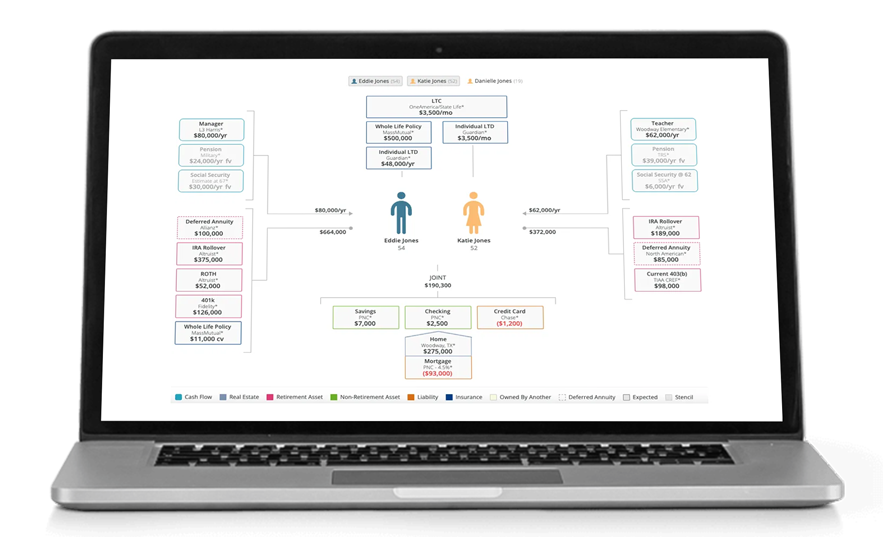
- Both partners' accounts, insurance, and obligations on one page
- See what each of you would want to know before a planning conversation
- Then explore planning strategies that may fit your household
Prefer to talk first? Pick a date and time that works for you.
Important disclosures
The polo team is an analogy, not a prediction. Asset-Map® is a trademark of its owner, an independent software company that Acanto uses as a service provider.
00:08Your life is constantly changing. So are financial markets. If every rider chases the ball, who's defending the goal? Your investments need a game plan too. Each color is an asset class.
00:20See how the mix changes? That's adaptive investing at Acanto. Our adaptive eight strategy ranks 22 asset class ETFs or exchange traded funds and selects the best performing eight each month. Why would a pioneer of efficient markets pay attention to price trends? In their study of stock returns, Nobel laureate Eugene Fama and Kenneth French wrote, the premier anomaly is momentum.
00:45Stocks and asset classes that led often kept leading for a time. We measure those trends to decide what to own. How much should we own? In eight a, we use risk parity where more volatile holdings get smaller weights and vice versa. This adaptive investing philosophy guides everything we do.
01:03Think of your family's wealth plan as a polo team. Every position has a job. Our top 20 concentrated equity plays drive offense alongside other growth strategies. In the midfield, eight a can shift between assets and self adjust based on volatility, while other strategies add diversity. For income and balance, alternative and managed futures ETFs, credit funds, and interval funds can diversify exposure and income streams.
01:28On defense, cash reserves can cover near term spending. Life insurance, long term disability, and annuities can help protect the people who depend on your income. Your asset map puts it all on one page. What do I own and what do I owe? What if you retired five years earlier?
01:45First, we look for gaps across the six L's. Liquidity, long term disability, life insurance, long term care, longevity, and legacy. When you become a client, we run multiple scenarios to see how all your assets fit together. Which account would fund those extra five years? What would that mean for your taxes, your spouse's income, and your legacy?
02:06Clarity first. Strategy second. Integrity always. We coordinate those choices with your tax and estate professionals. That's a game plan for your retirement and the people counting on you.
02:18Acanto LLC. Adaptive investing. Coordinated financial planning. Take about fifteen minutes today to fill out your asset map.